Bay bolete Imleria badia
- Season
- August to November
- After rain
- 6 to 13 days after at least 15 mm of rain
- Temperatures
- 8 to 18 °C
- Habitat
- Mainly conifers, sometimes broadleaves
- Soil
- Acid-loving (conifers) (pH 4 to 5.8)
 peak season: October
fig. 12I. badia
Right now
Edition of 23 November
- Morel
- St George's mushroom
- Bronze bolete
- Chanterelle
- Cep (penny bun)
- Parasol mushroom
- Field mushroom
- Horn of plenty
- Winter chanterelle
- Hedgehog mushroom
- Saffron milk cap
- Bay bolete
- Wood blewit
- Oyster mushroom
- fruiting
- starting
- quiet
- out of season
Bay bolete — fruiting: Allier, Charente, Charente-Maritime, Cher, Corse-du-Sud, Gers, Haute-Garonne, Hauts-de-Seine, Indre, Loir-et-Cher, Loire, Loiret, Lot-et-Garonne, Maine-et-Loire, Rhône, Saône-et-Loire, Vendée, Vienne; starting: Ariège, Aude, Aveyron, Deux-Sèvres, Dordogne, Essonne, Finistère, Gironde, Haute-Vienne, Hautes-Pyrénées, Indre-et-Loire, Landes, Nièvre, Paris, Sarthe, Seine-et-Marne, Tarn, Val-d'Oise, Yonne.
How to recognise it
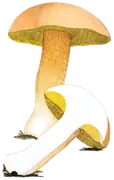
Cap 3 to 15 cm, uniform bay brown to chestnut brown, felty and matt in dry weather, distinctly sticky and shiny in damp weather. Tubes and pores cream then bright yellow, bluing strongly and quickly to blue-green when pressed with a finger. Stem cylindrical and slender, brownish on a yellow background, fibrillose, entirely smooth: no net, no ring, no red dots. Flesh whitish, yellowish near the tubes, bluing faintly, smell faint and pleasant. Mainly under conifers, on acidic soil.
Dangerous look-alikes
-
Devil's bolete
poisonousRubroboletus satanasDecisive feature: Whitish to putty-grey cap rather than bay brown, orange-red pores, a red-netted stem, on chalky soil.
Cap whitish to putty grey and not bay brown, pores orange-red, swollen stem with a red net; on chalky soil under broadleaves, whereas the bay bolete is acid-loving.
-
Bitter bolete
inedibleTylopilus felleusDecisive feature: White then dirty-pink pores that do not turn blue, a prominent dark-brown net on the stem; very bitter taste.
Pores white then dirty pink that do not turn blue, and a dark brown net standing out distinctly on the stem; very bitter taste of a fragment placed on the tongue then spat out.
When by altitude
| Altitude | J | F | M | A | M | J | J | A | S | O | N | D |
|---|---|---|---|---|---|---|---|---|---|---|---|---|
| 0–400 m983 obs. | · | ● | ● | · | ||||||||
| 400–1,000 m295 obs. | · | ● | ● | · | ||||||||
| 1,000 m+254 obs. | · | ● | ● | ● |
Months of precise observations submitted to GBIF (CC0 and CC BY datasets), by altitude band. ●: peak month, at least 15% of the band’s observations. Months under 5% of the band, or with fewer than 5 observations, are not marked. GBIF.org
Foraging tips
The rapid bluing of the pores is normal in this species and is not a sign of toxicity; on the other hand, any bolete with red pores or a bitter taste is to be discarded. Wipe the sticky cap skin before cooking and eat cooked.
Model reliability
Reliability for this species: high.
Validation details
AUC 0.86 · Boyce index 0.98, on an independent test: 204 GBIF records accurate to 250 m, never seen in training, compared with 6,000 random locations in France.
An AUC of 0.5 means chance, 1 means a perfect map.
The Sporia map shows the favourable spots forest by forest.
See the exact spots